
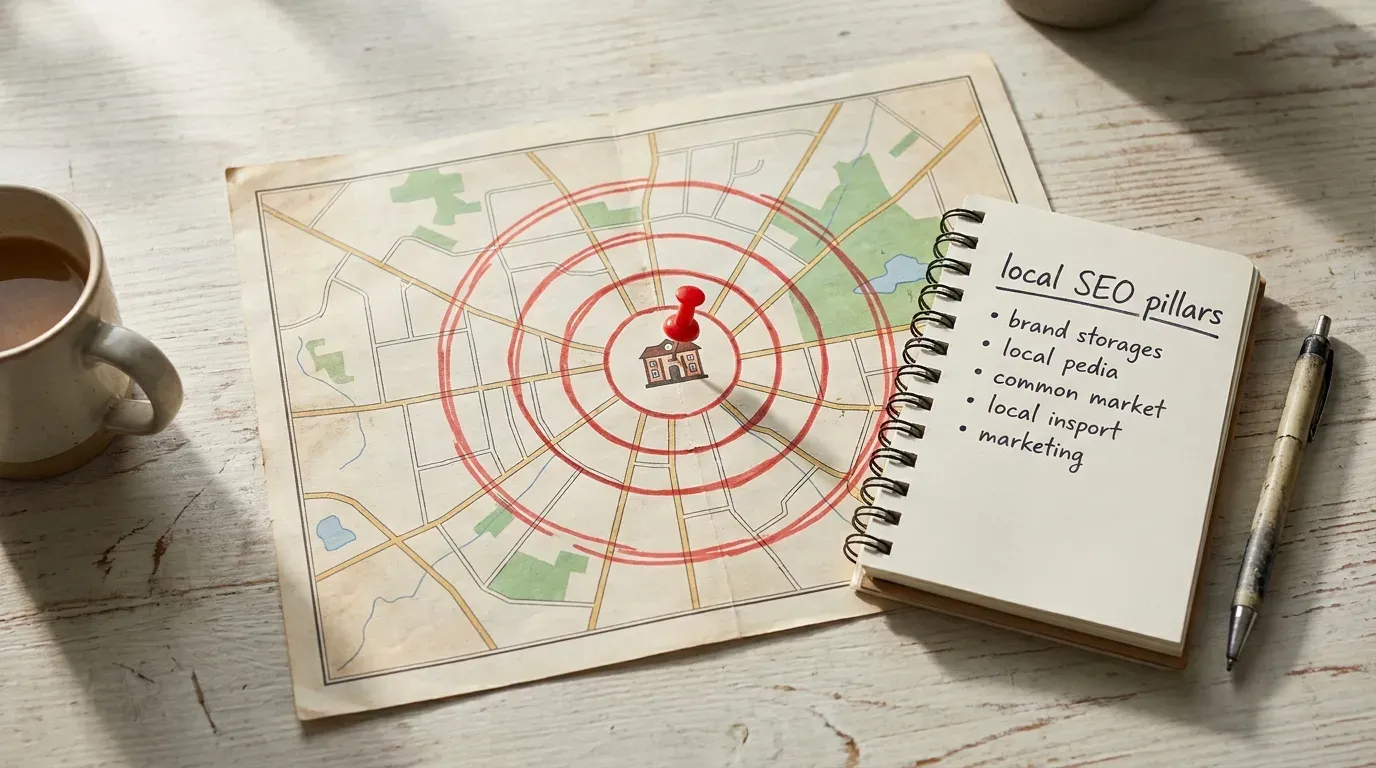
Local SEO is less a single tactic and more a set of seven concentric circles around your business. Each one is small on its own. Get any one wrong and your ranking dips a little. Get all seven right and you become the default result for every search that matters in your area, for free, forever.
This article is the full local SEO playbook I’d install at a brand new client. The seven pillars, the order to work them, and what “doing it well” actually looks like for each.
This is the strategic article. If you want the diagnostic version (“why am I not showing up at all”), read our Google visibility article instead. This article assumes you’re showing up and want to outrank competitors who are also showing up.

Photo by Jonathan Marchant on Unsplash.
What local SEO actually is
Local SEO is the work of ranking your business higher in two specific places:
- The Google Maps 3-pack (the three local businesses Google shows at the top of search results when somebody searches for a local service)
- Local organic results (the standard blue-link search results below the 3-pack, where local businesses with strong websites also appear)
Google ranks businesses in the 3-pack on three signals: proximity (how close the business is to the searcher), relevance (how well the business matches the search), and prominence (how established and trusted the business is across the web). Google’s own How to improve your local ranking help article (retrieved May 2026) names these three by name. You can’t control proximity. You can absolutely control relevance and prominence.
The 7 pillars of local SEO for small business
Treat this list as priority order. Most of the ROI is in pillars 1-3. Pillars 4-7 compound over time.
Pillar 1: Google Business Profile optimization
Your GBP is the foundation of local SEO. Most small businesses have a profile they set up once and never touched. “Doing it well” means:
- Verified with no suspension warnings
- Primary category set to the most specific relevant option (not “Restaurant” if you’re “Italian Restaurant”)
- All applicable secondary categories filled in
- Services section fully populated with terms customers actually search
- Business description (750 character limit) using natural language with the service + city woven in
- Hours accurate including holiday hours
- Photos uploaded monthly (Google uses photo recency as a ranking signal)
- Posts published weekly (updates, offers, events)
- Q&A section monitored and answered, including questions you ask yourself
- Products or menu populated where applicable
This is roughly 3 hours of setup work and 1-2 hours per month of maintenance. It’s the single highest-leverage time investment in your local SEO stack.
Pillar 2: NAP consistency across the web
NAP stands for Name, Address, Phone. Google cross-references these three pieces of information across hundreds of directories (Yelp, Apple Maps, Yellow Pages, BBB, Chamber of Commerce, industry-specific sites, social profiles) to decide whether your business is legitimate.
Inconsistency hurts. “Joe’s Plumbing LLC” on Google, “Joe’s Plumbing” on Yelp, “Joes Plumbing” on Apple Maps, and a different phone number on the BBB profile reads to Google as either multiple businesses or a sloppy single business; either interpretation lowers your trust score and your visibility along with it.
Whitespark’s Local Search Ranking Factors survey (retrieved May 2026) puts citation consistency among the top quartile of ranking factors year after year. What to do: pick one canonical version of your name, address, and phone, then audit your top 10-15 directory listings. Update any mismatches. Tools like Whitespark, BrightLocal, and Yext can help; we usually do it manually because the directories that actually move the needle are a small list.
Pillar 3: Reviews (quantity + recency + diversity)
Reviews are the highest-leverage ranking signal in the local pack. Higher than backlinks. Higher than your website depth. We have a whole article on the 10-step Google reviews process but the quick version: build an SMS-driven request workflow that fires within 48 hours of a positive customer interaction, reply to every review within 48 hours, and aim for steady review velocity (5-15/month for an active business).
Also: don’t put all your reviews on Google. Yelp, Facebook, and industry-specific platforms (Houzz, Angi, TripAdvisor, etc.) all signal prominence to Google even when Google doesn’t directly read them.
Pillar 4: Local content on your website
Your website should have a dedicated page for every service you offer AND every city you serve. Not the same page; separate pages. If you’re an HVAC company serving 8 towns, that’s at least 8 location pages plus your main service pages.
Each location page should include the city name in the URL, the title tag, the H1, and throughout the body content. NOT in a spammy way; in a natural “we serve [city] and the surrounding area” way that genuinely helps a searcher confirm you cover their area.
Add real local content: photos of recent work in that area, testimonials from local customers, mentions of local landmarks or events when relevant. Google’s algorithm distinguishes between cookie-cutter location pages and genuine local content. The cookie-cutter version doesn’t rank.
Pillar 5: Local backlinks
Backlinks from credible local sources tell Google that other local entities vouch for your business. The Google visibility article covered this in depth; the short version of what to target:
- Your Chamber of Commerce listing
- Your Better Business Bureau profile
- Local industry associations you’re a member of
- Partner businesses (offer to link to them in exchange)
- Local press (pitch a story or get quoted as an expert source)
- Local sponsorships (sports teams, charity events), since most include a link from the event’s site
- Local award nominations and “best of” lists
Five strong local backlinks beat fifty random directory submissions. Focus on quality.

Photo by Fujiphilm on Unsplash.
Pillar 6: Schema markup on your website
Schema markup is structured data you embed in your website’s HTML that tells Google explicitly what your business is and what it does. For local SEO, the relevant schemas (per schema.org’s LocalBusiness specification, retrieved May 2026) are:
- LocalBusiness (or a more specific subtype like Restaurant, Plumber, Dentist, etc.)
- Service (one per service page)
- Review (aggregated reviews if you’re confident in your data)
- FAQPage (on any page with an FAQ section)
- BreadcrumbList (so Google understands your site hierarchy)
Most modern website builders (Webflow, Wordpress with Yoast, Shopify) make this easy. If your site doesn’t have schema markup, it’s almost certainly costing you visibility on every search.
Pillar 7: Mobile and technical SEO basics
70%+ of local searches happen on mobile. If your site is slow on mobile, doesn’t render well on small screens, or has broken elements, Google ranks you lower regardless of how good the rest of the local SEO work is.
The mobile checklist:
- Loads in under 3 seconds on a 4G connection
- All buttons and forms are tappable without zooming
- Phone number is clickable to call directly
- Address is clickable to open Maps directions
- No horizontal scrolling on any page
- Core Web Vitals all green in Search Console
How to improve local SEO for small businesses, by stage
Month 1: Foundation
GBP fully optimized. NAP audit and fixes. Schema markup added to website. Review collection process installed. Most of the immediate visibility gains happen in this first month; many businesses see Maps ranking improvements within 2-4 weeks of getting these foundations right.
Months 2-6: Content + reviews + backlinks
Publish location pages for every city you serve. Publish service-specific content. Maintain steady review velocity. Earn 5-10 local backlinks. Keep GBP fresh with weekly posts and monthly photos.
Months 6-12: Compounding
Your business starts ranking on terms you weren’t targeting. Reviews snowball as your visibility increases. Local backlinks accumulate organically. The work shifts from setup to maintenance plus opportunistic expansion.
For the full timeline expectations, the SEO timeline article goes deeper. Local SEO is faster than general SEO; expect visible gains in months, not quarters.
Local SEO checklist for small business
Quick reference. If you can check off most of these, you’re ahead of 80% of your local competitors:
- GBP verified, fully populated, and updated within the last 30 days
- Primary GBP category is the most specific one Google offers for your business
- Secondary GBP categories include every relevant variant
- GBP photos uploaded within the last 30 days
- GBP posts published within the last 14 days
- NAP matches exactly across Google, Yelp, Apple Maps, Facebook, BBB, Chamber of Commerce, and your top 5 industry directories
- At least 50 Google reviews, with the most recent within the last 14 days
- Reply rate on reviews is 100%
- Website has a dedicated page for each service
- Website has a dedicated page for each city/region you serve
- Each page has the city or service in the URL, title, H1, and body
- LocalBusiness and Service schemas implemented
- Mobile loads in under 3 seconds
- Core Web Vitals all green in Search Console
- At least 5 credible local backlinks
- Your name appears (unlinked is fine) in at least 3 local news or blog mentions
Most small businesses I audit can check 4-7 of these. Hitting 12+ usually means landing in the top 3 of the local pack.
Common local SEO mistakes
- Stuffing keywords into the business name field on GBP (“Joe’s Best Plumbing Atlanta GA Emergency 24/7”). Against Google’s guidelines and a fast track to suspension.
- Setting up the GBP and never updating it. Stale profiles slowly lose visibility relative to active ones.
- Cookie-cutter location pages with the same content and just different city names. Google penalizes these.
- Asking for “5-star reviews” specifically. Against Google’s guidelines.
- Buying backlinks or paying for directory submissions to obscure sites. Either useless or actively harmful.
- Treating local SEO as a one-time setup rather than an ongoing maintenance practice. The businesses that win at local SEO are the ones who keep the work going year after year.
FAQ
Local SEO tips for small businesses, in one paragraph?
Optimize your Google Business Profile aggressively (categories, services, posts, photos, hours). Make sure your name, address, and phone are identical everywhere on the web. Build a review-collection process that asks every happy customer by SMS within 48 hours. Publish location-specific and service-specific pages on your website with schema markup. Earn 5-10 backlinks from local Chamber, industry associations, and partner businesses. Reply to every review within 48 hours. That’s local SEO in 200 words.
Local SEO strategies for small businesses that actually work?
The strategy is the seven pillars in this article. The work is doing them all consistently for 6-12 months. Most businesses fail at local SEO not because the strategy is wrong but because they stop after 60 days when they don’t see immediate ranking changes. Local SEO compounds; the businesses that win are the ones still doing the work in month 18.
Local SEO services for small business: should I hire someone?
Most small businesses can do pillars 1-3 themselves with a few hours per month. Pillars 4-7 benefit from specialized help, especially the content and backlink work. If your business is in a competitive category (legal, medical, home services in a major metro), hiring help compresses the timeline meaningfully. If you’re in a low-competition area or niche, DIY is fine.
Average cost of local SEO for small business?
Local-SEO-specific retainers typically run $500 to $2,500/mo for SMBs. Full-service marketing agencies (our SEO timeline breakdown) include local SEO inside a broader retainer. DIY is free except for tools ($30-100/mo if you use a citation management or rank tracking service).
Importance of local SEO for small businesses, briefly?
If your business serves customers in a specific area, local SEO is the highest-ROI marketing channel available. It’s free in dollar terms (just time), it compounds over years rather than degrading like ads, and customers who find you through local search are usually higher-intent than customers from any other channel. Ignoring it is leaving real money on the table.
Beefed Up runs the full local SEO stack for established small businesses across the US. We pair it with brand, web, and Google Ads work so the whole funnel pulls in the same direction. Get in touch if you want an audit of your current local SEO with specific next steps.


