
The single highest-leverage hour of marketing work a small business can do this week isn’t running ads, isn’t writing content, and isn’t redesigning the website. It’s setting up a three-line text message that goes out after every completed job, asking customers for an honest Google review. Most small businesses never do it. The ones that do quietly crush their competitors at local SEO without doing anything else.
And yet most small businesses I audit have somewhere between 8 and 30 total Google reviews, most over a year old, with the most recent reply from the business being three years ago. Meanwhile their best competitor has 280 reviews from the last 18 months and a thoughtful reply on every one.
This article is the process I install at every client we onboard. The exact mechanics of asking, the rules of what to send and what not to, how to handle negative reviews, and the tools that automate most of it. Nothing here is theoretical; this is the workflow that produces 80+ reviews per year for the average client we run it for.
Why Google reviews matter more than you think
Reviews do three jobs that nothing else in your marketing stack does as well:
They rank you higher on Google Maps
Review quantity and recency are direct ranking factors in Google’s local pack. A business with 80 fresh reviews will outrank a business with 200 reviews from 2020 in the same category, in the same area, in the same week.
They convert prospects who already found you
The average customer reads 7-10 reviews before contacting a local business, per BrightLocal’s Local Consumer Review Survey (retrieved May 2026). If yours are sparse or stale, they bounce to a competitor with a fuller profile.
They lower your cost per lead on every other channel
Google Ads quality score improves with high-rated landing experiences. Click-through rates improve when your listing shows 4.8 stars. Cost per acquisition drops across the board.
In my experience, going from 25 reviews to 100 reviews changes a small business’s Google Maps visibility more dramatically than any other single intervention available to it. Faster than SEO. Faster than ads. Faster than rebuilding the website. And it’s nearly free.
The one rule that 10x’s your review request response rate
Send the review request by SMS, not email.
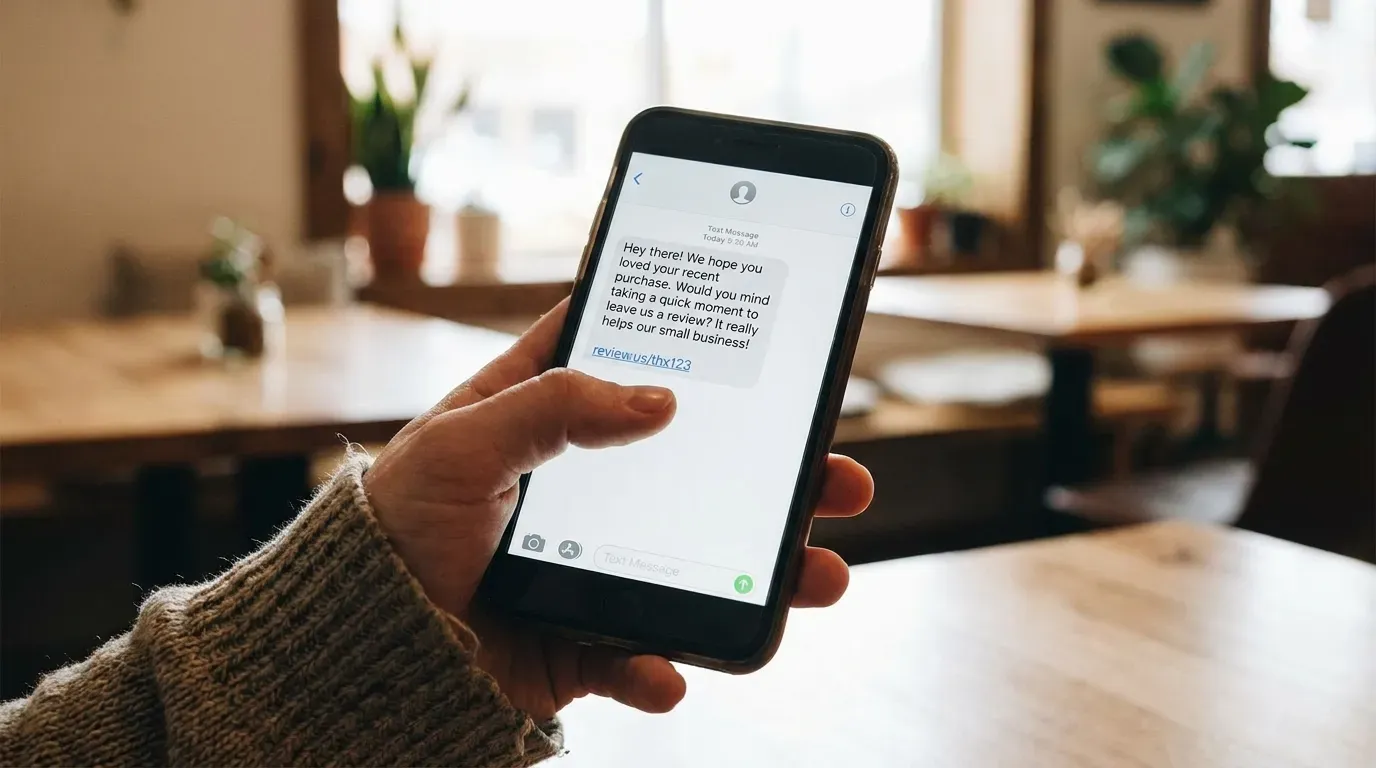
Across every client we’ve installed this for, SMS review requests get 3-5x the response rate of email requests, with a median around 35-45% completion vs. 8-12% for email. The math doesn’t even close. If you can only do one thing differently after reading this article, switch your review requests from email to SMS and your review count will roughly triple over the next 90 days.
Why? Email is where customers receive 80 newsletters they didn’t sign up for, so they ignore most messages from businesses by default. SMS is still mostly personal contacts and important notifications, so customers read every text. The friction of clicking a review link is roughly the same on both channels; the difference is entirely whether the message gets opened at all.
The 10-step Google review process
This is the workflow we install at every client we run reviews for. Walk through it once and customize for your business; the principles are the same regardless of category.
Step 1: Generate your direct review link
Go to business.google.com, select your Business Profile, find the “Get more reviews” option in the dashboard, and copy the short link. It looks like g.page/r/[random-string]/review. This is the only link you’ll send. Don’t send the long Google Maps URL; the short link goes straight to the review form.
Step 2: Decide WHO gets asked
Every customer who had a positive experience. Don’t filter to your favorites; ask everyone who didn’t complain. The temptation to only ask customers you’re sure will leave 5 stars is real and you should resist it. Honest reviews including occasional 4-star reviews actually boost credibility (a profile with 100% 5-star reviews looks suspicious).
Step 3: Decide WHEN to ask
Within 24-48 hours of the positive customer interaction. The feeling is still fresh, the goodwill is at its peak, and the cognitive cost of writing a review is at its lowest. Wait two weeks and the response rate halves.
Step 4: Write your SMS template
Short. Personal. No corporate tone. Something like:
“Hi [Name], thanks again for choosing [Business]. If you’ve got 60 seconds, would you mind leaving a quick review on Google? Helps a ton: [your-review-link] - [Your name]”
That’s it. Don’t ask for “five stars”, because it’s against Google’s review content policy (retrieved May 2026) and reads as transactional. Don’t write a paragraph; people don’t read long texts from businesses. Don’t include the business’s full URL or any other links; keep the friction to one click.
Step 5: Send from a person, not a robot
If technically possible, send from your real number, not a marketing-automation tool’s number. Customers respond to messages from people, not platforms. If you’re using a tool (CallRail, BirdEye, etc.) make sure the SMS number presents as a real local number, not a 5-digit short code.
Step 6: One reminder, never more
If the customer doesn’t respond in 5-7 days, send one follow-up. Something like “Hey [Name], just a quick bump on that review - if you have a moment, the link is here: [link]. Totally fine if not!”. One reminder. Never a third message. The second message captures another 8-12% who genuinely meant to but forgot; the third message annoys.
Step 7: Automate the trigger, not the message
Connect your CRM, scheduling tool, or POS system to fire the SMS automatically X hours after a job is marked complete or an order ships. The send is automated; the customer experience stays personal because the message looks human. Most service businesses can do this with Zapier and any SMS tool (CallRail, Twilio, Textmagic). E-commerce platforms have built-in versions.
Step 8: Reply to every review within 48 hours
Positive reviews get a short, warm, personalized reply that mentions something specific from what they said. Negative reviews get a calm, public, problem-solving reply (more on this below). Generic “Thanks for your business!” replies on every review look as automated as they are; don’t do them.

Step 9: Add review keywords to your replies
When you reply to a positive review, casually include service-related keywords your business wants to rank for. “Glad we could get your AC unit running again before the heat wave” includes “AC” naturally. Google reads your replies as additional content on your profile and weighs the words in them for relevance scoring.
Step 10: Audit monthly, adjust quarterly
Check your new review count each month. If it’s not climbing steadily (5-15 per month for an active small business), something in the funnel is broken. Audit the trigger, the SMS deliverability, the response rate, the asking timing. The system is mostly self-running once installed but it needs occasional attention.
How to handle negative reviews
You will get negative reviews. Some of them will be unfair, untrue, or from people who weren’t even your customer. Handling them well actually builds more trust than a profile of pristine 5-stars.
The framework:
Respond within 24 hours
Speed matters more than perfect wording. A delayed reply signals you didn’t notice or didn’t care.
Acknowledge the experience without admitting fault
“We’re sorry your experience didn’t meet your expectations” is better than “You’re wrong about what happened” even if you think you’re right.
Move the conversation offline
“We’d like to make this right. Please call us at [number] so we can dig into what happened.” Don’t litigate the dispute in the public reply.
If the review is fake or violates Google’s policy, flag it
Reviews from non-customers, reviews with profanity or hate speech, reviews from competitors. Google removes a meaningful percentage of flagged reviews; it’s worth the 30 seconds.
Don’t argue. Ever
Even if you’re 100% in the right, every public business owner who argues in review replies looks defensive. Future customers reading the reply will trust the calm response and discount the angry customer.
Strong handling of one negative review converts more prospects than the rest of your 4.9-star profile, because prospects assume good handling under pressure is the truer signal of how you run the business.
What NOT to do
Things that will hurt you more than help. All of these are against Google’s contribution policies (retrieved May 2026) and will eventually result in review removals or profile penalties:
- Offering discounts, gift cards, or any incentive in exchange for a review
- Asking for “5-star” reviews specifically (you can ask for an honest review)
- Writing reviews for your own business from different accounts
- Paying for fake reviews from any service that promises them
- Filtering reviews so only happy customers reach the review form (sometimes called “review gating”, which Google explicitly bans)
- Buying reviews from existing customers post-facto (“hey would you leave a review and I’ll send you a $20 gift card”)
Google’s detection of these is better than people assume. They cross-reference IP addresses, account histories, reviewing patterns. The accounts that buy fake reviews routinely have their entire review profile zeroed out when the algorithm catches up.
Tools that automate this
You don’t need a tool to run this process; SMS, a spreadsheet, and discipline work fine. But if you want to automate it:
CallRail Reviews
$45-95/mo. Already in the stack for service businesses doing call tracking. Trigger SMS from a closed call.
BirdEye / Podium / Grade.us
$200-500/mo. Dedicated review-management platforms. Overkill for businesses doing under 30 reviews/month but useful at scale.
Zapier + Twilio + Google Sheets
~$40/mo combined. DIY automation that works fine. Connect any CRM trigger to a Twilio SMS template.
Square / Shopify built-ins
if you’re using these for POS or e-commerce, they have native review request features. Free, but less customizable than the dedicated tools.
FAQ
How to get more Google reviews for free?
Ask every happy customer by SMS within 48 hours of the positive interaction, with a short personal message and a direct review link. That’s the free version of the entire system. If you do nothing else from this article, do that.
How to get more Google reviews fast?
The fastest legitimate path: ask every customer from the last 90 days who you didn’t ask at the time. Send a one-off SMS thanking them for past business and asking for a review if they have a minute. Response rates are lower than fresh post-service asks but the volume is real. Expect 5-20 reviews from a typical 90-day customer list.
Can I pay customers to leave Google reviews?
No. Direct incentives for reviews violate Google’s policies. Google may remove the reviews, suspend your profile, or both. Indirect incentives (free coffee for all customers) are technically fine because they aren’t tied to leaving a review specifically, but stay on the safe side and don’t tie any value to the review itself.
Does replying to Google reviews actually help?
Yes, in two distinct ways. Reply rate is a quiet ranking factor in local SEO, so businesses that reply to most reviews outrank businesses that don’t. And prospects reading your profile see the replies and judge how you handle relationships from them; a thoughtful reply on a 2-star review converts better than a profile of unanswered 5-stars.
What if my business has a lot of old, bad reviews?
Recency matters more than total history in Google’s ranking model. If you start collecting fresh positive reviews now, you’ll outweigh the old negative ones in both ranking and the average rating within 6-12 months. Old reviews matter less than people fear; they fade in relevance fast.
Beefed Up installs the review collection process as part of our marketing service for established small businesses. Get in touch if you want a real review system installed and running in your business inside 30 days.


