
The honest answer is 6 to 12 months. Almost every SEO agency selling you their services will round that number down to look fast; most SEO blogs round it up to look smart about being patient. Neither version reflects how the work actually plays out for a small business.
So this article is the version with timelines that match real client outcomes, not the optimistic marketing-material version. For a small business in 2026, expect meaningful organic traffic in 6-12 months. Expect SEO to be a real revenue driver in 12-24 months. Faster than that is almost always either lucky or temporary.
Below: why it takes that long, what’s happening at each phase, what variables compress or stretch the timeline, and the leading indicators that tell you you’re on track before traffic shows up.
Why SEO takes longer than ads
Google Ads work in 24 hours because you’re paying for placement. SEO works in 6-12 months because you’re earning it. The mechanic is fundamentally different.
When Google decides whether to rank your website above a competitor’s, it’s evaluating signals that take time to accumulate:
- Has anybody linked to this site?
- Has the site existed for a while?
- Does the site get traffic from somewhere besides Google itself?
- Have real users clicked through and stayed on the page?
- Are there reviews, mentions, citations across the web?
None of those signals can be manufactured overnight. They accumulate over months. Google’s own How Search Works documentation (retrieved May 2026) is explicit about ranking being a function of signals that compound over time; the system is built to favor sites that have demonstrated value, not sites that just went live.
How long does SEO take to work, by phase
The realistic timeline for a small business with a new or low-authority domain, doing serious SEO work:

Months 0 to 3: Foundation (no visible traffic gains)
This is the technical setup phase. Schema markup, page-level SEO (titles, meta descriptions, headers, internal linking), site speed optimization, Google Business Profile fully built out, the first 3-5 service or product pages written in depth, sitemap submitted to Google Search Console.
What you’ll see: the pages start getting indexed (you’ll see them appear in site:yourdomain.com searches). Impressions in Search Console start ticking up slightly. Almost no actual traffic. If you’re checking Google Analytics expecting growth this month, you’ll be disappointed, and that’s normal.
Months 3 to 6: Early signals (small traffic, mostly branded)
Google starts ranking your pages for low-competition keywords. Mostly long-tail variants and your own brand name. Total organic traffic is probably 50-300 visitors per month if you’re doing the work, vs. 10-30 if you’re not.
What you’ll see: some non-brand search queries showing up in Search Console (these are golden, save them). The first leads from organic search trickle in. Your Google Business Profile starts ranking better for nearby “near me” searches. You’ll feel like nothing’s happening because the numbers are still small.
Months 6 to 12: Compounding starts (the elbow of the curve)
If the foundation is solid and you’ve kept producing content monthly, this is where the line in your traffic chart starts curving upward. Pages that were ranking on page 3 move to page 1. New pages rank faster (Google has more trust in the domain). Backlinks start appearing organically because the site is becoming a real resource.
What you’ll see: 5-10x more organic traffic than month 3. Multiple keyword rankings on page 1. The first months where organic delivers more leads than a small paid budget could. This is the phase where SEO investment starts visibly paying off.
Months 12 to 24: Real revenue driver
Compounding accelerates. Each new article or service page now publishes onto an established domain and ranks faster. Older pages still gain rankings as link equity accumulates. Organic traffic at this point is usually 10-30x what it was at month 3 for businesses doing the work consistently.
What you’ll see: SEO becomes a top-2 lead source for your business. The cost per lead from organic is roughly $0 (you’ve already paid for the work that’s now producing). Paid acquisition often gets reduced or rebalanced because organic is filling the pipeline.
Year 2+: Maintenance with upside
Once you’ve reached this phase, SEO becomes maintenance work plus opportunistic expansion. Keep publishing. Keep updating older content. Keep earning backlinks. Each year compounds on the last.
Variables that change the SEO timeline
The 6-12 month timeline assumes a small business doing serious SEO work on a new or low-authority domain. Real timelines vary a lot based on:
Domain age and history
A brand-new domain (registered this month) takes longer to rank than a 5-year-old domain. Google trusts older domains more, with everything else equal. If you’re starting from a new domain, expect to be on the slower end of the timeline.
Competition in your category and location
“Plumber in Manhattan” is a brutally competitive search. “Plumber in a town of 8,000 in Iowa” is mostly empty. Less competition means faster ranking, even with less work. If your category is competitive, expect to be on the slower end of every phase above.
Content velocity
Publishing one in-depth article per month is the baseline I’d consider “doing SEO seriously.” Publishing four per month roughly halves your timeline to compounding. Publishing one per quarter stretches it out to 18-24 months. Content cadence is the single biggest variable.

Photo by Amelia Bartlett on Unsplash.
Technical foundation
If your website is slow, doesn’t have schema markup, has broken internal linking, or runs on a platform with bad SEO defaults (some Wix themes, some old Wordpress setups), Google will rank you slower than equivalent sites with cleaner technical foundations. Fixing the technical floor often produces visible ranking gains within 4-8 weeks.
Backlinks and citations
Earning a handful of credible local backlinks (Chamber of Commerce, local press, partner businesses) can compress the timeline noticeably. Each strong backlink is a vote that you exist and somebody else vouches for you. Unlinked mentions across the web also help. The Google visibility article has more on the prominence side of this.
How long does SEO take to work for a new website?
Slower. A new website (less than 6 months old) is starting from zero domain authority. The same SEO work that would produce results in 6 months on an established domain takes 9-15 months on a brand-new domain.
The workaround isn’t to skip the SEO work; it’s to run paid ads in parallel to generate traffic, leads, and engagement signals while the organic side matures. Paid traffic and organic SEO actually work better together than either does alone, because the user behavior signals from paid traffic indirectly help your organic rankings.
How long does SEO take for [specific industries]?
Quick reference for the categories I get asked about most:
Local service businesses (HVAC, plumbing, landscaping, etc.)
4-9 months for visible results, 12-18 months for SEO to be a top-2 lead source. Local SEO is faster than national/general SEO.
Restaurants
3-6 months for Maps visibility, faster than most categories.
Law firms
8-15 months. Extremely competitive category; expect the longer end of the timeline.
Medical and dental practices
6-12 months. Local SEO compresses this timeline; national medical content is much slower.
E-commerce
6-18 months depending on category. Niche products can rank fast; broad categories are brutal.
B2B SaaS
9-18 months. B2B SEO is the slowest of the categories I work with, because the competitive content is usually well-funded and the keywords are often broad.
Leading indicators (how to know SEO is working before traffic shows up)
If you’re 4 months into SEO work and impatient, look at these instead of total traffic:
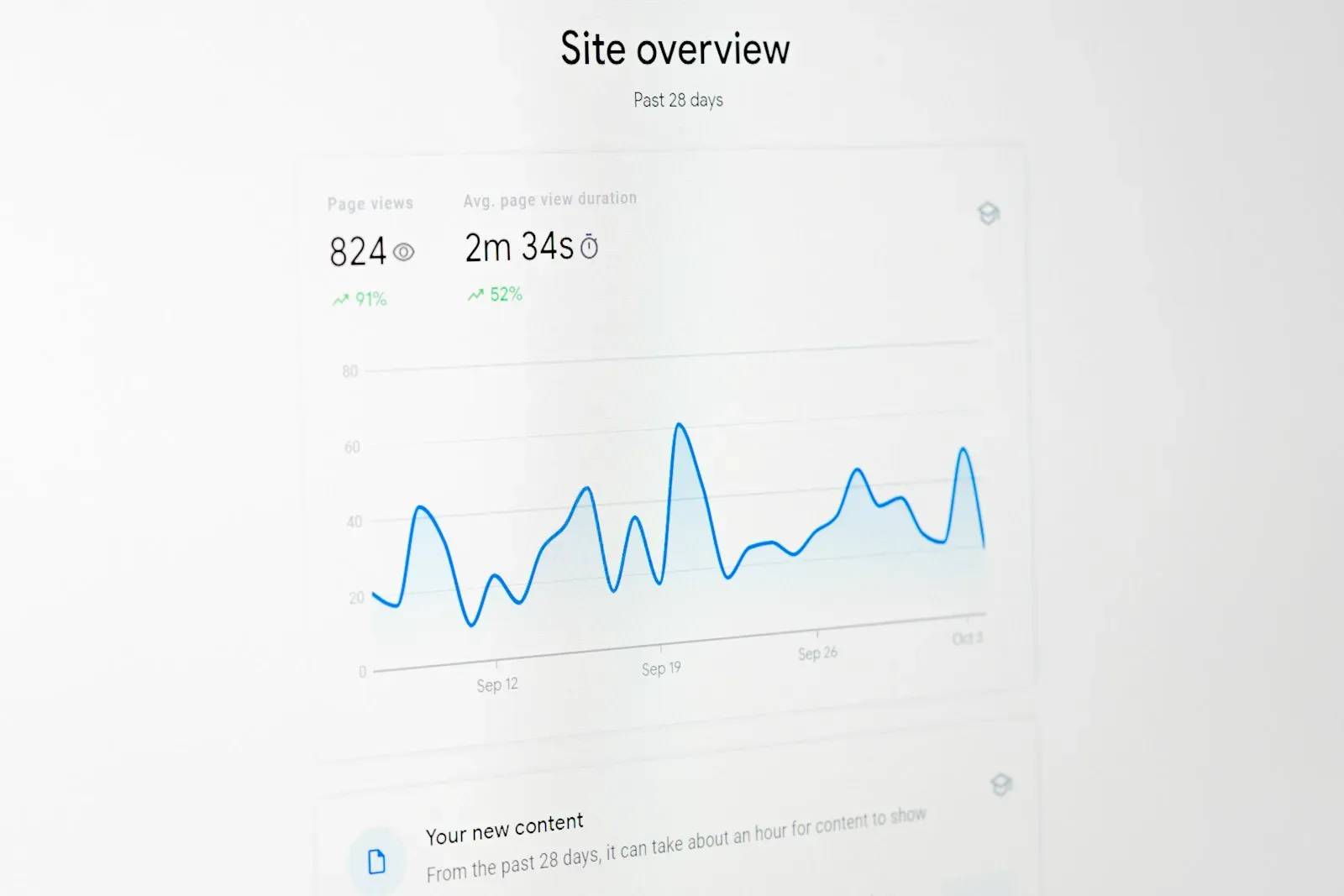
Photo by Justin Morgan on Unsplash.
Indexation rate
Search Console > Pages. Are your new pages getting indexed within 1-2 weeks of publishing? If yes, good. If no, technical problem worth investigating.
Impressions trend (not clicks)
Search Console > Performance. Impressions show up before clicks. If impressions are growing month over month, traffic is coming.
Average position trending up
Even moving from position 38 to position 15 isn’t visible traffic, but it’s measurable progress.
Branded search volume
Search Console > Queries containing your brand name. If branded searches are growing, your overall brand awareness is increasing, which feeds organic visibility.
New backlinks
Track via Ahrefs, Semrush, or Search Console > Links. Even one or two strong new backlinks per quarter is meaningful.
How to know when to stop or pivot your SEO
Some SEO investments don’t pay off, and you should know when to cut. Signs the strategy isn’t working:
- 12 months in and impressions are flat or declining (not just clicks, impressions)
- No new keywords appearing in Search Console month after month
- Pages aren’t getting indexed despite proper submission
- Manual action or algorithmic penalty showing in Search Console (rare but real)
If you’re seeing all four, something’s wrong with the strategy or the execution, and continuing to spend without changing approach won’t fix it. Usually the fix is a technical audit, a content quality reassessment, or a recognition that the keywords you’re targeting are too competitive for your current authority level.
The honest pitch: paid + organic together
If you’re running a small business that needs leads this quarter and also wants compounding organic growth, the answer isn’t “do SEO instead of ads.” It’s both.
Run paid search for the leads you need now (Google Ads budget framework here). Build SEO for the leads you need in 12 months. Use the calculator to figure out the budget split: marketing budget calculator.
FAQ
How long does SEO take to see results?
First measurable signals (impressions, indexation, low-competition keyword rankings): 3-4 months. First meaningful traffic gains: 6-9 months. SEO as a real revenue driver: 12-24 months. Faster than that is usually luck or a temporary algorithm boost; slower than that is usually a strategy problem.
How long does SEO take to kick in for a new website?
A brand-new website (less than 6 months old) typically takes 9-15 months to see meaningful SEO traffic, vs. 6-12 months for an established domain. The site needs time to accumulate domain trust signals before Google ranks it competitively.
How long does SEO take to update on Google?
Page-level changes (titles, meta descriptions, content updates) typically reflect in search results within 1-4 weeks for active sites. Major structural changes (URL changes, site migrations, large content rewrites) can take 2-6 months to fully propagate.
Can SEO work in less than 6 months?
For very specific scenarios: yes. Hyper-local keywords with no real competition, branded searches, long-tail variants nobody else is targeting. For the keywords that actually drive meaningful business: almost never. If anyone promises you ranking for competitive keywords in 90 days, walk away.
Is SEO worth it for a small business?
Yes, with caveats. SEO is the highest-ROI marketing channel I work with over a 24-month horizon. It’s also the slowest to show returns. If you can commit to consistent investment for 12-24 months without flinching, SEO will become your cheapest source of leads. If you can’t, skip it and run paid ads instead.
Beefed Up builds the SEO foundation, content cadence, and Google Business Profile work that compounds into organic traffic over 6-24 months. We pair it with Google Ads for clients who need leads now while the organic side matures. Get in touch for an honest timeline on your specific category.


