
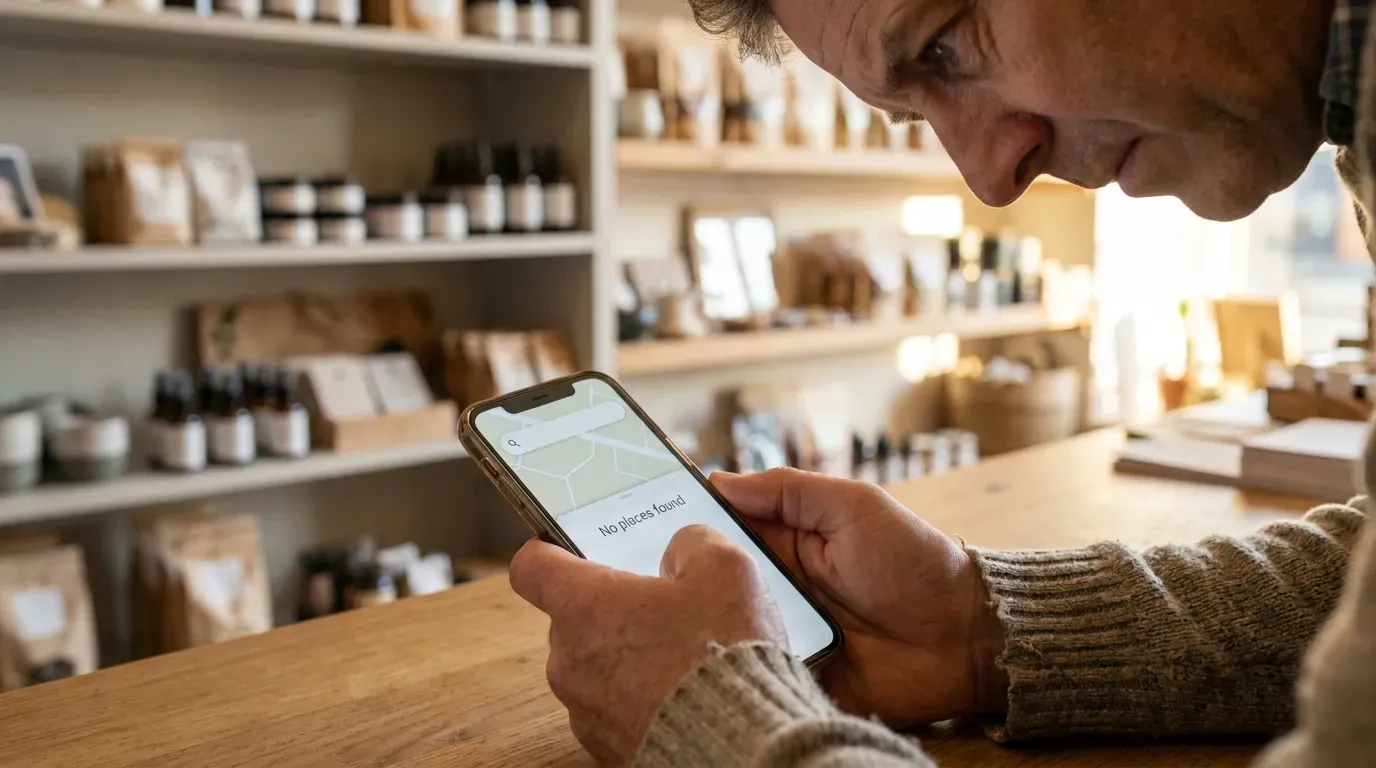
You type your own business name into Google Maps. The map zooms to your block. The pin doesn’t drop. The screen reads “no places found” in faint gray text. You know the business exists. You can walk into it. You can answer the phone in it. But Google can’t see it, which means new customers can’t either, which means it might as well not exist as far as next month’s revenue is concerned.
It’s a particular kind of small business panic, and the surprising part is that the same nine specific causes are behind almost all of it. Most of them are fixable in an afternoon. A couple take a few weeks. None of them are a death sentence.
Here’s the list, nine real reasons your business isn’t showing up on Google, with the actual fix for each. Start with the diagnostic at the top so you don’t waste an afternoon chasing the wrong one.
First, what “not showing up” actually means
Before the list, one quick reality check. When somebody tells me their business isn’t showing up on Google, they usually mean one of three different things, and the fix depends on which one it is.
Not on Google Maps at all.
You search your business name and Maps says nothing matches. This is almost always a Google Business Profile problem.
On Maps, but not ranking for the searches that matter.
You appear when somebody searches your exact name, but nowhere for “[your service] near me.” This is a relevance and prominence problem.
Used to show up, doesn’t anymore.
You had a listing, it ranked, and one day it stopped. This is almost always a suspension, a change Google didn’t like, or a competitor outranking you.
Figure out which one you’re dealing with before you start fixing anything. Otherwise you’ll spend three hours chasing the wrong problem.
Reason 1: Your Google Business Profile isn’t verified yet
This is the most common one I see, and the most fixable. If you set up a Google Business Profile but didn’t complete the verification step, your listing exists in Google’s database but doesn’t appear in public search.
How to check: log into business.google.com and look at the top of your dashboard. If it says “Verify now” or anything other than “Verified,” that’s your problem.
What to do
complete verification using whichever method Google offers you. As of 2026, that’s usually a video call, a postcard, or (for some categories) a phone code. Video is fastest if it’s an option. The postcard method still works but takes 7-14 days, and roughly a third of postcards never arrive in our clients’ experience.

Photo by Tim Mossholder on Unsplash.
Reason 2: You’re verified, but Google doesn’t think you’re relevant
This one’s the most frustrating. You’re verified. The listing exists. You show up when somebody types your exact business name. But for the searches that actually drive new business, you’re invisible.
Google ranks Maps results on three factors, in roughly this order: proximity (how close you are to the searcher), relevance (how well your listing matches the query), and prominence (how established Google thinks your business is). Google publishes this explicitly in its How to improve your local ranking on Google help article (retrieved May 2026). If you’re verified but not ranking, you’re losing on one of the latter two.
What to do
go through your profile field by field. Pick the most specific primary category Google offers (not “Restaurant” if you’re “Italian Restaurant”). Add every applicable secondary category. Fill in the services list with the actual terms your customers search for. Add photos every month. Publish posts. Treat the profile like a living asset, not a setup task.
Reason 3: Your name, address, or phone number doesn’t match across the web
This is called NAP inconsistency. Google cross-references your business information across hundreds of directories (Yelp, Yellow Pages, Apple Maps, the Better Business Bureau, your Chamber of Commerce, your industry-specific sites) and uses the consistency of that data to decide whether you’re a legitimate, established business.
If your phone number is different on Yelp than on Google, if your address is missing the suite number on one but not the other, if your name shows as “Joe’s Plumbing” here and “Joe’s Plumbing LLC” there, Google quietly downgrades your trust score and your visibility along with it.
Industry research backs this up. Whitespark’s annual Local Search Ranking Factors survey (retrieved May 2026) consistently puts citation consistency among the top influences on Local Pack rankings, separate from the website-side signals most agencies obsess over.
What to do
pick the version you want to be canonical (the exact name, address, and phone as you want it everywhere). Then audit your top 10-15 directory listings and update each one to match. Tools like Whitespark, Yext, or BrightLocal can do this for you. We do it manually for our clients because the directories that actually move the needle are a small list, and a tool that updates 200 obscure citations is mostly noise.

Reason 4: Your listing is suspended, and Google didn’t email you
This one’s the silent killer. Google will occasionally suspend a Business Profile for a real or alleged policy violation: a category mismatch, a name that includes keywords (“Best Plumber Atlanta”), an address that doesn’t match a real physical location, a stuffed services list. They don’t always send an email. Sometimes you just stop appearing.
Google’s Business Profile suspension policy (retrieved May 2026) lists the qualifying violations, but in practice the trigger is often a small detail you’d never guess from reading the policy.
How to check: log into business.google.com and look for any banner at the top mentioning suspension or appeal. Also try searching your business name in Google Maps from a fresh browser. If the listing literally doesn’t exist (not just buried in results), you might be suspended.
What to do
file a reinstatement request through the dashboard. Be specific about what you think the issue was and how you’ve fixed it. Reinstatement can take anywhere from 3 days to 3 weeks. I’ve had clients reinstated in 48 hours and others who waited a month for the same kind of issue. There’s no formula. Be polite and direct.
Reason 5: You’re searching from the wrong location
This sounds dumb, and then you check, and you realize it’s the answer.
Google Maps personalizes results based on where the searcher physically is. If you’re testing your own visibility from your home Wi-Fi but your business is 12 miles away, Google might show you a competitor closer to your house, even if your business outranks them for searches near the business itself.
What to do
test your visibility from the actual location of the business, or from where your typical customer would be searching. There’s also a free tool called Local Falcon that simulates searches from a grid of GPS points around your address, which gives you a real picture of where you’re visible and where you’re not. Worth $30/mo for any local business.
Reason 6: Your website is too thin for Google to vouch for you
Google Business Profile and your website are two sides of the same coin. Your GBP tells Google what you do and where. Your website confirms it. If your website is one page, has no real content about your services, doesn’t mention your city, and doesn’t link to or from your GBP, Google has nothing to corroborate the listing with.
What to do
build out real service pages on your website. Each major service should have its own page, with the service name in the URL, in the H1, and naturally throughout the body copy. Mention your city or service area. Embed your GBP information (NAP) in the footer of every page. Link to your GBP from your contact page. We covered the full case for this in our article on why every small business needs a website and we go deeper in our web design service.
Reason 7: Your reviews are the single biggest local SEO lever, and you’re not pulling it
For local search specifically, reviews are weighted more heavily than almost any other ranking signal. More than backlinks. More than your domain age. More than the depth of your website. BrightLocal’s Local Consumer Review Survey (retrieved May 2026) and Whitespark’s local ranking factors data both put review signals in the top three influences on Local Pack ranking. In my experience, a business with 80 fresh reviews will outrank a business with a stronger website and zero reviews almost every time, in the same category and the same city.
Both quantity and recency matter. A business with 50 reviews over the last two years will usually outrank a business with 200 reviews that all came in during 2020 and then stopped. Google reads a steady review stream as proof that the business is real, busy, and trusted right now.
What to do
build a review-collection process into your normal post-service workflow. After a job is done or a sale is closed, send a short text or email with a direct link to your Google review form. Don’t ask for “five stars” (against Google’s guidelines and feels gross anyway), just ask for an honest review. The single biggest review unlock for most of our clients is sending the link by SMS, not email. Text response rates are 3-5x higher in the campaigns we’ve measured.
Three details most businesses miss:
Diversify the sources.
Google ranks businesses higher when reviews show up across multiple platforms (Google, Yelp, Facebook, industry-specific sites like Houzz, Angi, or TripAdvisor). Not because Google reads Yelp directly, but because review presence across the web reinforces that you’re a real, established business.
Encourage detail.
Long-form reviews that mention specific services (“they replaced our hot water heater on a Sunday”) signal relevance to Google for those service searches. Don’t script reviews, but don’t be afraid to remind customers what you did for them when you ask.
Reply to every review.
Positive and negative. Reply rate is a quiet ranking factor and a public trust signal in equal measure. Generic replies are fine for short positive reviews; thoughtful replies are required for any negative review (Google notices when you defuse complaints publicly, and so do your prospects).

Photo by Towfiqu barbhuiya on Unsplash.
Reason 8: Your business has no online prominence (no backlinks, no mentions, no press)
Google’s local ranking model has three pillars: proximity (how close you are), relevance (how well your listing matches the search), and prominence (how established and authoritative Google thinks your business is). The first two are mechanical. The third is everything else: who links to you, who mentions you, who’s written about you, how long you’ve been online. Google’s local ranking documentation (retrieved May 2026) names these three by name as the factors that determine Maps results.
Prominence is the slow-build pillar, and it’s the one most small businesses ignore because the work isn’t visible from a dashboard. In my experience, businesses that have everything else dialed in but no online prominence get stuck just outside the local pack, ranking 4th to 7th when they should be ranking 1st to 3rd.
What actually counts as prominence:
Backlinks from credible local sources.
Your Chamber of Commerce listing, a mention on the local newspaper’s website, a partner business that links to your contact page, your industry association directory. Each one is a small vote that you exist, you’re real, and somebody else vouches for you. Five solid local backlinks beat fifty random directory submissions.
Unlinked mentions.
Even when a website mentions your business name without a hyperlink, Google’s crawlers register the citation. A local blog post about “the best pizza in Austin” that names your shop has SEO value even without a link.
Press and editorial coverage.
Local business journals, community newsletters, podcasts, “best of” lists. These are rare to earn but disproportionately powerful when they happen.
Industry-specific platforms.
If you’re a contractor: Houzz, Angi, Yelp, BBB, Thumbtack. If you’re a restaurant: OpenTable, TripAdvisor, Eater. The industry-specific sites count toward prominence even when Google doesn’t directly reference them.
Age and consistency.
A business that has been online for 7 years with consistent NAP, steady reviews, and ongoing content updates is more “prominent” than a business that registered its domain last month, even if both are equally good in real life.
What to do
in your first 90 days of focusing on local visibility, deliberately earn 5 to 10 backlinks from credible local sources. Your Chamber, your Better Business Bureau profile, any industry association you’re a member of, any local business you partner with (offer to link to them in exchange), local press (pitch a story or comment quote). It’s slow work. It’s also the work that separates the businesses that rank from the ones that don’t.
Reason 9: You used to show up, and you don’t anymore
If your listing was ranking and stopped, something specific changed. The most common culprits, ranked by what I’ve actually seen:
You moved or changed your address.
Google takes weeks (sometimes months) to fully re-trust a new address. During the transition, visibility tanks.
You changed your primary category.
Treat category changes like a fresh launch; the listing needs time to re-rank.
A competitor finally got their profile in order.
If someone in your area suddenly started doing the work you weren’t (reviews, posts, photos, NAP), they may have overtaken you organically.
A suspension you didn’t notice.
See reason 4.
Google updated their algorithm.
Local Pack updates happen quietly a few times a year. Search Engine Land’s local SEO coverage (retrieved May 2026) is the most reliable public log of these; if your visibility dipped on a specific date, that’s where to start.
Figure out which of these matches your timing and work the fix from there.
How to audit your Google visibility in 30 minutes
If you’re reading this and your business isn’t showing up, here’s the half-hour audit that catches 80% of the issues.
Verify your Google Business Profile status
Log into business.google.com. Confirm the dashboard banner reads Verified and shows no suspension notice. If it says Verify now, complete verification before anything else.
Search your exact business name on cellular
Open Google Maps on your phone over cellular data, not Wi-Fi. Search your exact business name. Confirm the pin drops on your address. No pin means a profile problem, not a ranking problem.
Test a service query near the business
From a location near your business, search ‘[your service] near me’ or ‘[your service] in [your city]’. Note your rank in the local pack. If you’re not in the top 3, that’s a relevance or prominence issue, not a verification one.
Audit NAP consistency on top directories
Open Yelp, Apple Maps, and the Better Business Bureau. Compare name, address, and phone to your Google Business Profile. Flag any mismatches in spelling, suite numbers, or phone formatting. Even small inconsistencies hurt.
Check review count and recency
On your Google Business Profile, note the total review count and the date of the most recent review. A profile whose newest review is older than 90 days reads as stale to Google, regardless of how many older reviews you have.
Confirm website NAP and service pages
Open your website. Confirm name, address, and phone are visible in the footer of every page. Confirm each major service has its own dedicated page (URL, H1, and body all mention the service by name). A thin website undermines a strong profile.
Most issues surface in these six steps. The fixes are then the hard part, but at least you’re chasing the right problem.
The honest bridge: paid search while you fix the organic side
Here’s the part most articles on this topic won’t tell you. Even after you fix every reason on this list, getting your organic Maps visibility back can take weeks or months. Google updates trust scores slowly. NAP changes propagate slowly. Suspensions get reinstated on Google’s timeline, not yours.
In the meantime, you still have a business that needs new customers, and customers who are searching right now.
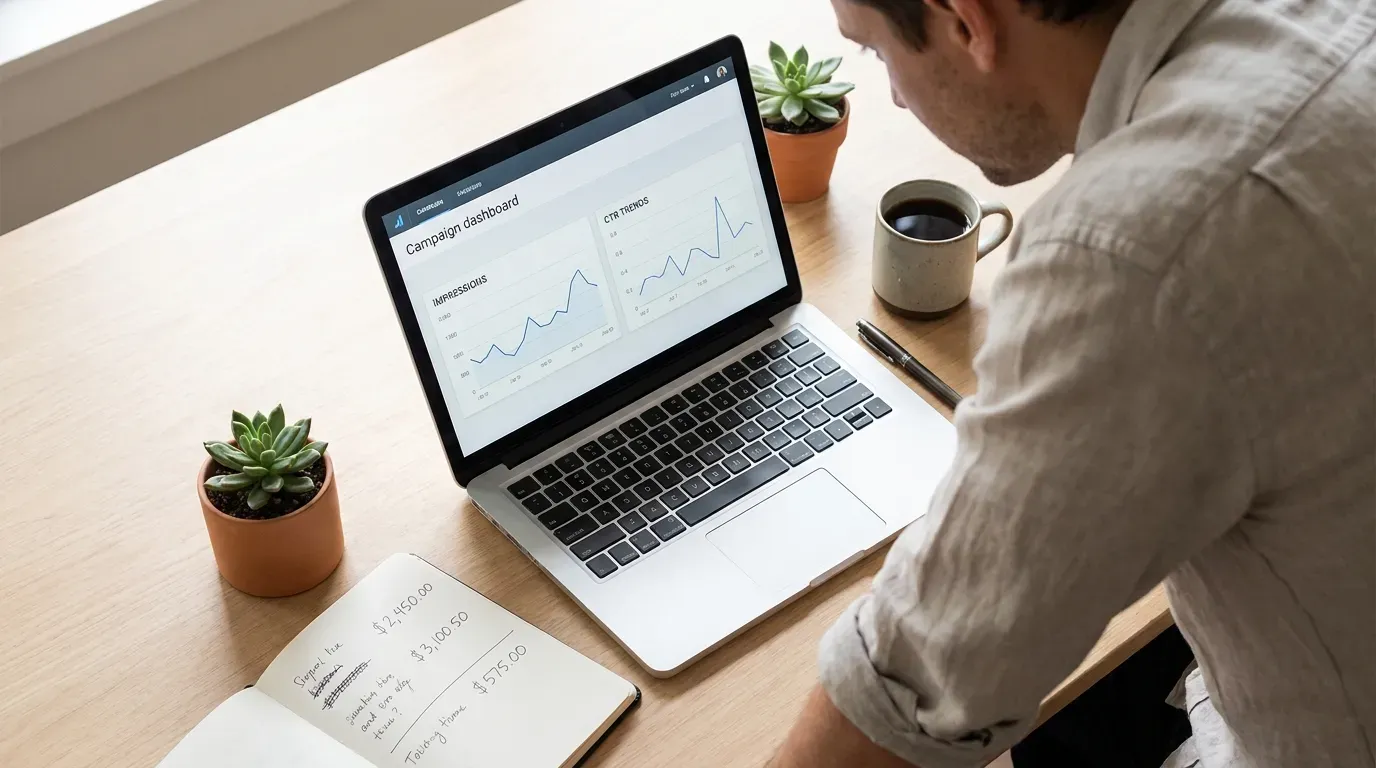
That’s the case for running Google Ads or Local Service Ads specifically during the organic rebuild window. Not forever; not as a replacement. As bridge financing for visibility while the organic side catches up. The rough monthly numbers are in our marketing budget calculator, and there’s a longer breakdown of what those numbers actually buy at small-business scale in our budget article.
FAQ
Why is my business not showing up on Google Maps?
Almost always a Google Business Profile issue: unverified, suspended, miscategorized, or a NAP mismatch with the rest of the web. Work through reasons 1, 3, and 4 above before anything else.
Why is my business not showing up on Google after verification?
Verification just gets you into the database. It doesn’t earn you ranking. After verification, Google needs time (typically 2-6 weeks) to crawl your profile, cross-reference it with the rest of the web, and decide where to place you. During that window, you’ll often appear for your exact business name but nowhere else. Use the time to add categories, photos, services, posts, and reviews.
Why is my business not popping up on Google search (not Maps)?
Google Search and Google Maps use different but related ranking systems. If you’re invisible on Search specifically, the issue is usually on the website side: thin content, no schema markup, no real backlinks, or your domain is too new for Google to trust. Fix the website and the Search visibility usually catches up over 2-3 months.
How long does it take for a new business to show up on Google?
From a clean start: 1-2 weeks to appear at all once verified, 6-12 weeks to start ranking competitively for non-brand searches. Faster if your category is uncompetitive in your area. Slower if you’re going up against established chains.
Can Google Ads help if my business doesn’t show up organically?
Yes, and that’s often the right move while you fix the organic side. Google Ads doesn’t require any of the organic ranking signals; you can pay to appear at the top of search results immediately, even if your Maps listing is suspended. It’s not a long-term replacement for organic visibility, but it’s a perfectly legitimate bridge.
Beefed Up runs Google Business Profile cleanup, local SEO, and Google Ads for established small businesses across the US. If your business isn’t showing up where it should be, get in touch. We’ll audit your listing and tell you honestly whether it’s a 30-minute fix or a 3-month project.


