How to choose a marketing agency (the 8-step process for a small business)
By Kael Broersma, Founder of Beefed Up. We run brand, web, and Google Ads for established small businesses across the US.

Before you sign that marketing agency proposal, work through this. Eight questions, none of them about pricing (we covered pricing in the agency pricing article); all of them about whether the agency in front of you can actually do the work and whether they'll be honest with you while they do it.
Choosing a marketing agency is one of those decisions where most small business owners feel underqualified to evaluate the options. The pitches all sound similar. The case studies are curated. The prices are opaque. And the cost of picking wrong is usually a year of wasted budget plus the lost momentum of having to start over.
I've been on both sides of this. I've sat in client chairs evaluating agency pitches, and I've sat in agency chairs trying to win business. So this article is the version of the selection process I'd hand to a friend asking me how to pick one. Eight steps, the red flags worth walking on, the specific questions to ask in the pitch meeting, and how to read a proposal critically. No filler.
Before you start: what kind of agency do you actually need?
"Marketing agency" is a category that covers wildly different shops. Before reading proposals, get specific about which kind you actually need:
- Full-service agencies do brand, web, paid media, content, and SEO under one roof. Best for established SMBs that want one team handling the whole stack.
- Paid media specialists focus on Google Ads, Meta, etc. Best when you have a clear funnel and just need the traffic side handled well.
- Brand and design studios focus on identity, website, and creative. Best for one-time foundational work.
- SEO and content agencies focus on organic growth. Best when you're playing a long game and have budget for 6-18 months without flinching.
- Industry-vertical agencies only work with one category (lawyers, dentists, restaurants). Best when your business is in their vertical and you want category-specific expertise.
Picking the wrong category is the most common mistake. A pure Google Ads shop won't fix a broken brand. A brand studio won't run your ad account well. Be honest about what you actually need before you start evaluating agencies.
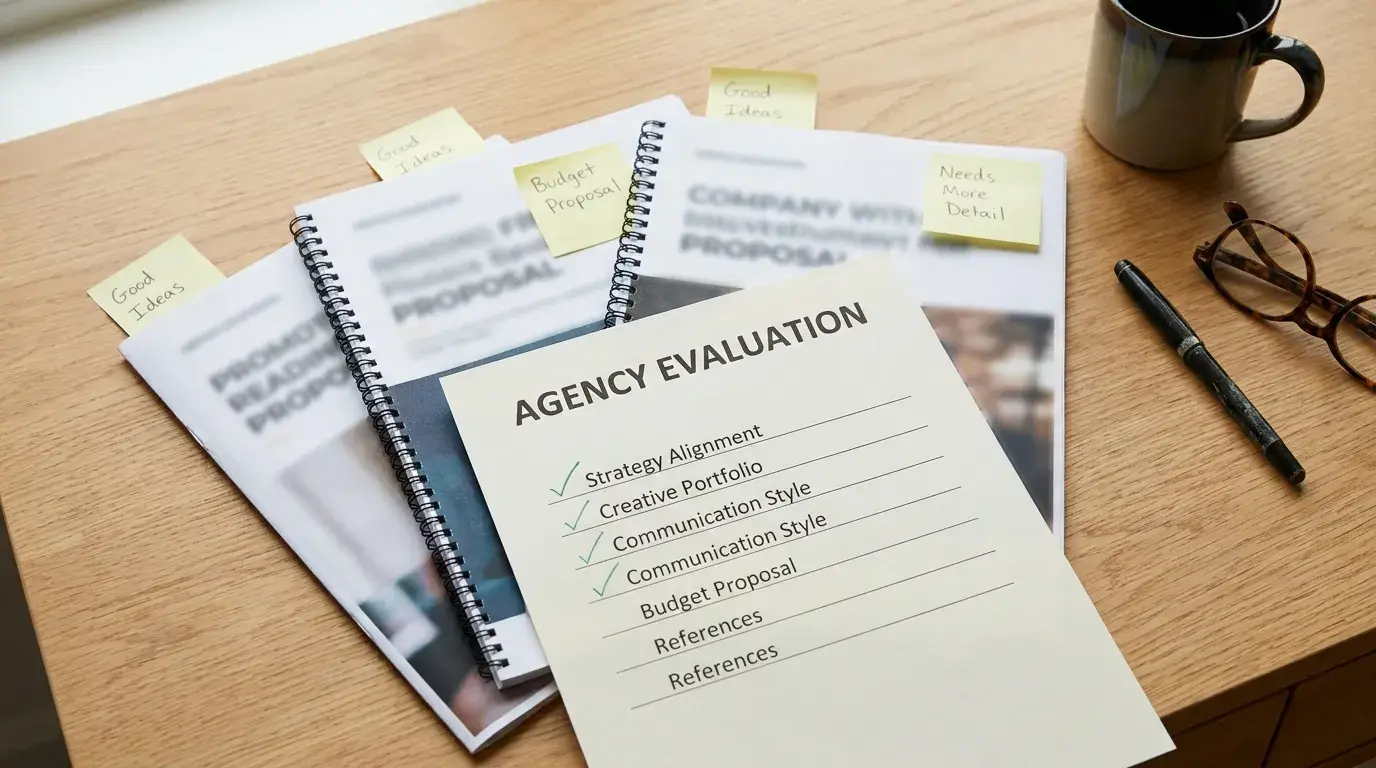
The 8-step process for choosing a marketing agency
Step 1: Define what success looks like before you talk to anyone
Write down three things you want the agency to accomplish in their first 6 months, with measurable criteria. "More leads" doesn't count; "50% more qualified leads from organic search" does. "Better brand" doesn't count; "a refreshed site that visibly reflects who we are and converts cold traffic 30% better than the current site" does.
If you can't write that down, the agency can't deliver it. The clarity of your success criteria is the single biggest predictor of whether an agency engagement will work.
Step 2: Build a shortlist of 3 to 5 agencies
Source candidates from three places: referrals from business owners you trust who've worked with agencies (highest signal), agencies that show up well on your own searches (decent signal), agencies that have published meaningful content in your category (decent signal). Avoid agencies that found you (cold outbound) unless they've also done one of the above.
Three to five candidates. More than that and you'll spend more time evaluating than working. Fewer and you don't have enough comparison.
Step 3: Scan their own marketing before the first call
This is the single highest-leverage step most SMBs skip. Look at the agency's own website, blog, social, and Google Ads (if they run them) before you talk to them. If their own brand is sloppy, their own SEO is weak, or their own ads are off-target, they will do the same to yours.
This filter alone disqualifies about a third of the shortlist most of the time. That's healthy.
Step 4: Run the discovery call with specific questions

Photo by Rodrigo Rodrigues on Unsplash.
In the first call, don't let them give the pitch. Ask:
- What three things would you do in our first 90 days?
- What does "success" look like to you in our category?
- Who's the most similar client you've worked with, and what did the engagement look like?
- What's the biggest reason you'd decline to work with us?
- Who specifically would be on our account, and what's their experience?
Pay attention to whether the answers feel rehearsed vs. genuinely thought-through. The best agencies will ask you twice as many questions as you ask them.
Step 5: Ask for a proposal with specific scope
"Send me a proposal" produces vague documents. Instead, ask for a proposal that specifically addresses the three success criteria you wrote down in step 1. Tell the agency: "In your proposal, please specifically address how you'd accomplish these three things, what the monthly investment would be, and what the timeline looks like."
Agencies that respond with a proposal that ignores your criteria and pitches their generic services are signaling they don't listen. Walk away. The marketing plan article covers what to expect on the dollar side once proposals start coming in.
Step 6: Evaluate the proposal critically
A good proposal includes: a specific deliverable list (not just "manage your social presence"), a clear monthly fee with what's included, a separate line for ad spend (never bundled), a timeline with milestones, a reporting cadence, and a clear exit clause. If any of those are missing or vague, ask before signing.
Red flags in a proposal:
- "Starting at" pricing with no ceiling
- Long contracts (24+ months) with high cancellation fees
- Bundled ad spend (you can't see the actual management fee)
- Vague deliverables
- No mention of who specifically does the work
- Promises of specific results in specific timeframes ("#1 on Google in 60 days" is not a real promise)
Step 7: Reference-check at least one current and one former client

Photo by Vitaly Gariev on Unsplash.
Ask for two references: a current client (still active) and a former client (relationship has ended). Both are essential. Current clients tell you about the working relationship; former clients tell you about how the agency handles the end of a relationship, which is more informative.
On the call, ask: How does communication actually work day to day? What happens when something goes wrong? What's something the agency could be doing better? If you were doing this over, would you hire them again?
Step 8: Start with a small commitment, then scale
Don't sign a 24-month contract with a new agency. Start with a 90-day pilot, or with the shortest minimum commitment they offer. After 90 days you'll have real data on whether the relationship works. Then commit longer if it does.
The agencies that push hardest for long commitments up front are usually the ones whose work doesn't earn renewals on its own merits.
How to choose the right marketing agency for your business specifically
The general framework above gets you to a clean shortlist. The right pick from that shortlist depends on three things specific to your business:
Your stage
Pre-launch businesses need agencies that can build foundations (brand, website, basic infrastructure). Established businesses need agencies that can execute on a growth motion. Growth-stage businesses need agencies that can scale what's already working. Match the agency's strength to your stage.
Your team's capacity
Some agencies expect a marketing lead on your side to brief them and review work. Others can run autonomously with quarterly check-ins. If you have zero in-house marketing capacity, you need an autonomous agency; if you have a strong marketing manager, you can work with a more collaborative agency that lets you direct strategy.
Your decision speed
Agencies that work well with fast-moving businesses are different from agencies that work well with slow-moving ones. If your business signs off on creative same-day, partner with an agency that ships fast. If you have a five-person review committee, partner with an agency built for that pace.
Common mistakes when choosing a marketing agency
- Picking the cheapest option. Agency work is labor-intensive; below the market rate, somebody is cutting corners.
- Picking the agency with the flashiest website. Their own marketing is one signal among many. A polished agency that can't execute is more dangerous than an unpolished one that can.
- Choosing based on the senior person in the pitch. The senior person rarely does your day-to-day work. Ask who does, and meet them.
- Skipping references. The single highest-leverage 30 minutes of the entire selection process. Don't skip.
- Signing a long contract before validating fit. Start small, scale once it's working.
When to walk away from a marketing agency
During the selection process:
- They can't articulate what they'd do in the first 90 days
- Their references aren't reachable or aren't enthusiastic
- The proposal doesn't match what you asked for
- They're cagey about who does the work or what's included
- They promise specific outcomes on specific timelines (especially in SEO)
After the engagement starts:
- Reporting is delayed or missing
- Communication slows down after the first month
- Account-team turnover within the first 6 months
- The work doesn't reflect direction you've given
- Performance flatlines and the agency keeps recommending "more budget" as the answer
It's better to leave a bad agency relationship at month 4 than to spend another 8 months hoping it improves. The sunk cost is real but the future cost of staying is usually higher.
FAQ
How to choose the right marketing agency for your business?
Match the agency category to what you actually need (brand vs. paid vs. SEO), build a shortlist of 3-5 candidates, scan their own marketing before the call, ask specific questions in discovery, get a proposal that addresses your specific success criteria, reference-check two clients, start with a short commitment. The 8-step process above is the version of this I'd hand to a friend.
How to choose a digital marketing agency vs. a traditional one?
For most small businesses in 2026, digital is the only marketing that matters at meaningful scale. Choose a digital marketing agency unless you have a specific traditional channel (direct mail to a known list, event marketing, broadcast) that's already producing measurable results.
Should a small business hire a full-service agency or specialists?
Full-service when you want one accountable team and your needs span multiple disciplines. Specialists when you have a clear bottleneck (paid media isn't working, SEO is dead, brand is broken) and you want depth on that one thing. Most established SMBs benefit from a full-service agency once their budget is over about $3,000/mo.
How much should I expect to pay for a marketing agency?
The full breakdown is in our five-layer growth stack. Short version: most SMB monthly retainers land between $2,500 and $6,000, plus separately tracked ad spend. Below $2,000/mo, you're usually getting junior-level execution; above $10,000/mo at SMB scale, you're paying for capacity you can't fully use.
How long until I should expect results from a marketing agency?
Paid media results: 30-90 days. SEO results: 6-12 months for visible movement. Brand and website rebuilds: the work itself takes 6-12 weeks, then results compound over the next 6 months. If the agency doesn't have proof of motion (not necessarily results, but motion) within the first 30 days, the relationship is probably not working.
Beefed Up is a full-service marketing agency for established small businesses across the US. Brand, web, Google Ads, and the SEO infrastructure that compounds. Get in touch if you'd like to be on a shortlist or want a sanity check on a proposal you've received from somebody else.