How to write a marketing plan for a small business (the 7-section structure)
By Kael Broersma, Founder of Beefed Up. We run brand, web, and Google Ads for established small businesses across the US.

Most marketing plans are 30 pages long and do less work than seven well-structured paragraphs would. A marketing plan that actually moves the business is a seven-section document, one to two pages each section, that a real small business owner can read on Sunday night and execute starting Monday morning.
This article is what that actually useful small business marketing plan looks like. Not a 40-page template; not a vague mental model in your head that changes every Monday. A real 4-6 page document an owner can read in 10 minutes, hand to an agency or employee, and use to decide what to do next month.
Seven sections. Each section answers one specific question. Skip a section and the plan breaks; pad a section and nobody reads it.
What a marketing plan actually is
A marketing plan is a written answer to four questions:
- Where is the business right now?
- Where do we want it to be in 12 months?
- What are we going to do to close that gap?
- How will we know if it's working?
That's it. Everything in this article is a more specific version of those four questions. If your plan answers them well, it's a good plan regardless of length or format.
This is different from a marketing budget, which is the dollar-amount question. The marketing budget article covers that side; this article is about the plan that drives where the dollars go.
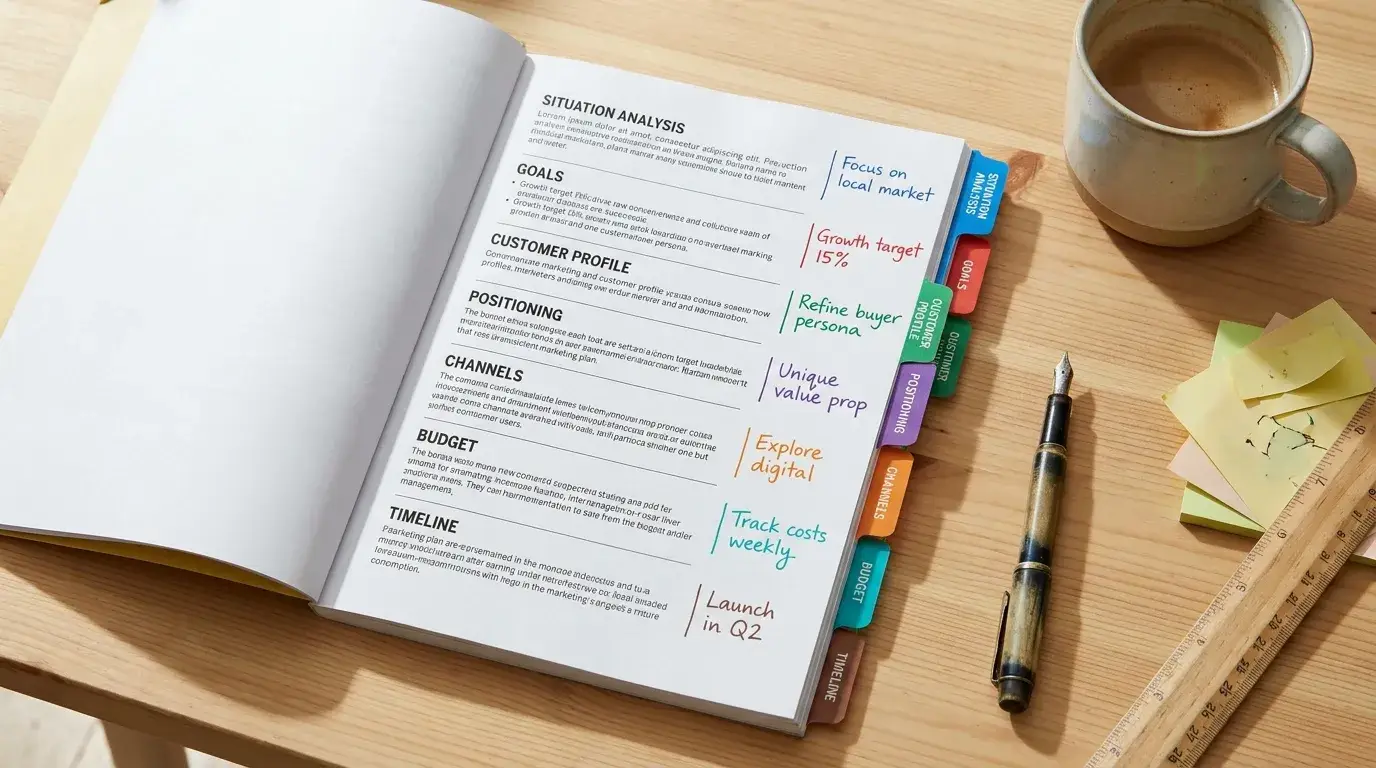
The 7-section structure of a real marketing plan
Section 1: Situation analysis (the honest version)
Two pages, maximum. Plain language. What you're writing here is a short, honest read on where your business is right now from a marketing perspective.
Include:
- Revenue last 12 months and growth rate
- Where leads are coming from (rough percentage by channel)
- What's working and what isn't
- Your top 2-3 competitors and what they appear to be doing differently
- Any major changes you're aware of (new competitor, market shift, regulatory change, your own capacity changes)
The honest version is the only useful version. "Marketing is hard" is not a situation analysis. "75% of our leads come from word-of-mouth, our website converts at 0.8%, our biggest competitor just launched a $5K/mo Google Ads campaign and started outranking us in Maps" is a situation analysis.
Section 2: Goals and KPIs (specific, measurable, dated)
Three goals max. If you have ten, you have none. Each goal follows the SMART framework (retrieved May 2026): specific, measurable, achievable, relevant, time-bound. One sentence per goal that includes:
- What outcome you want (more leads, more revenue, brand awareness in a specific market)
- Specifically how much
- By when
- Measured how
Example: "Grow qualified leads from organic search from 8/month to 25/month by end of Q3, measured in Google Analytics with our existing form-submission and call-tracking conversion events."
Bad version: "Increase online presence." There's nothing to do with that. There's no way to know if it worked.
Section 3: Target customer profile
Half a page. Who specifically are you marketing to? Not "small business owners" or "women aged 25-45." Specific.
Include:
- Demographics that matter (age, income, location, business size if B2B)
- The actual problem they're trying to solve when they encounter your business
- What they're searching for or scrolling through when they discover you
- What other options they consider before choosing you
- What specifically tips them from "considering" to "buying"
If you have three meaningfully different customer types, write three profiles. Most small businesses really only have one or two; the temptation to write six is usually a sign you don't yet know who your real customer is.
Section 4: Positioning and messaging
How you describe your business to a customer in the specific words they'll respond to. Two parts:
Positioning statement. One sentence: "We are the [category] for [target customer] who needs [outcome] and values [differentiator]."
Core message. A 2-3 sentence version of what your homepage hero, your ad copy, and your social bio should all say. The actual words. Not "we're committed to quality and innovation" (every business says that). Something specific: "We replace water heaters in a single visit, often the same day you call. Most other plumbers schedule it for next week. That's the difference."
If your positioning and messaging change, everything downstream changes. Lock this in before you commit channel budget.
Section 5: Channel strategy
Which channels are you using and what each one is responsible for. For a typical SMB, this is 3-5 channels max:
- Google Ads (responsible for: paid acquisition of high-intent search traffic)
- SEO + Google Business Profile (responsible for: long-term organic visibility, local pack ranking)
- Email (responsible for: nurturing existing customer relationships, repeat business)
- One social platform, whichever fits your customer (responsible for: brand awareness, trust-building, referrals)
- Reviews (responsible for: ranking, conversion, trust)
For each channel, write: what's the role, who's responsible for it, what's the monthly commitment in time or dollars. The growth stack article goes into more detail on how the channels work together; this section in the plan is just the assignment list.
The rule: don't add a channel until the existing channels are operating well. A plan that has 8 channels with $200/mo each will fail. A plan with 3 channels at meaningful investment will succeed.
Section 6: Budget allocation
Total monthly marketing budget, broken out by channel. The shape of this section:
- Paid acquisition (ad spend): $X
- Content and SEO (tools, freelance writers, hosting): $X
- Tools and tracking (analytics, CRM, call tracking, email platform): $X
- Creative (photography, design, copy refreshes): $X
- Buffer (5-10% for opportunities or tests): $X
Total monthly budget should be roughly 5-12% of annual revenue for established small businesses. For the full framework, use our marketing budget calculator. The budget article walks through the percentages by stage.
Section 7: Timeline and accountability
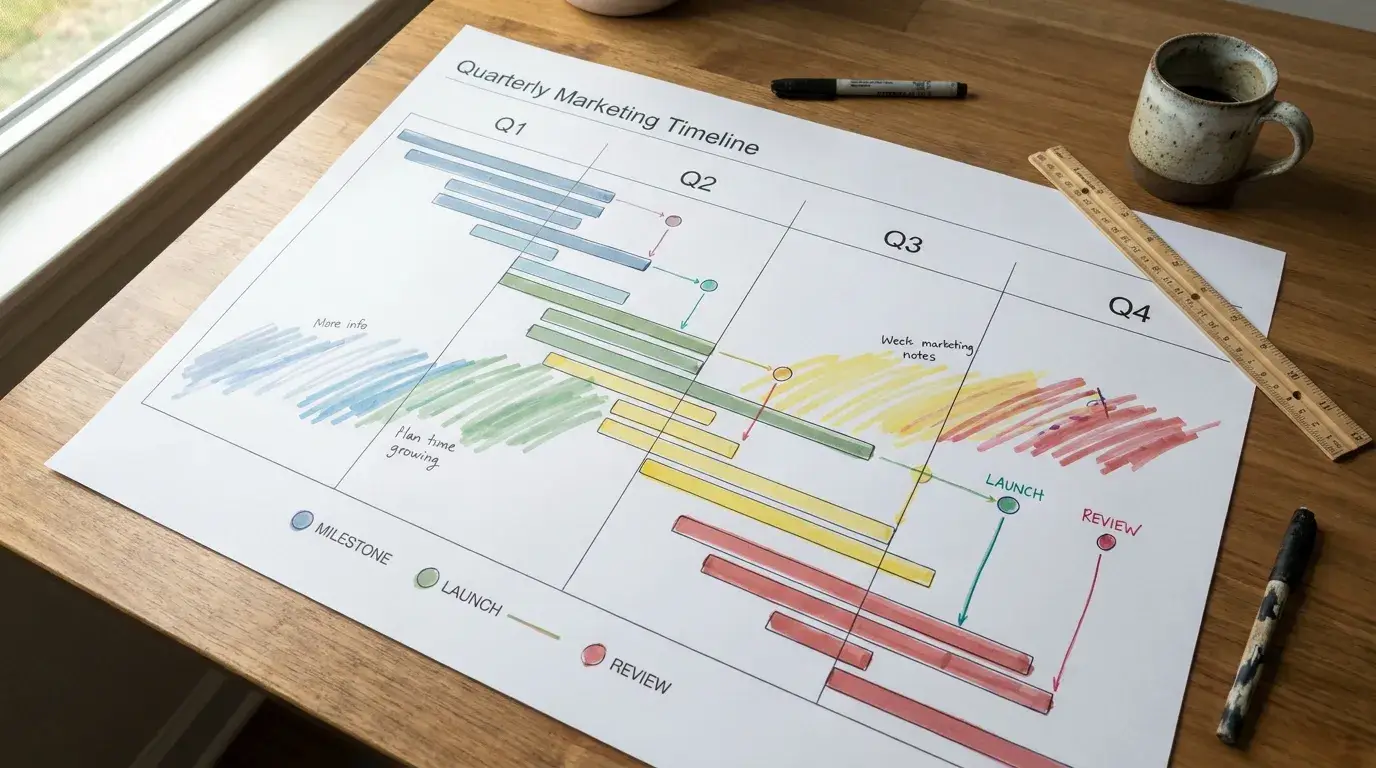
Half a page. The first 90 days mapped out, then quarterly milestones for the rest of the year.
For each month or quarter:
- What's being launched or worked on
- Who's accountable (named person, not a team)
- What we expect to see by the end of the period
- When we review and what triggers a course correction
This is the section that turns the plan from a document into a system. Plans without named accountability and explicit review cadences become wallpaper. Plans with them get executed.
How to write a marketing plan step by step

Photo by Compagnons on Unsplash.
If you've never written one and want a sequence, here's the order that works:
- Block 2 hours, alone, no phone. The first version doesn't get written in 15-minute increments. You need a single contiguous focus block.
- Open a blank doc and write Section 1 (situation analysis) honestly. If you can't be honest about where you are, you can't plan where you're going.
- Write 3 specific, measurable, dated goals. If you can't pick 3, pick 1. One real goal beats five vague ones.
- Write the customer profile in your own words. If it sounds like a textbook persona template, you're not done.
- Draft the positioning sentence and core message. Read them out loud. If they don't sound like you, rewrite.
- Pick channels and assign roles. Start with what's working; only add new channels if existing ones have room to grow.
- Set the budget by channel. Stay inside the 5-12%-of-revenue range unless you have a specific reason.
- Write the 90-day timeline with named accountability. Put dates on every milestone.
- Sleep on it. Read it again the next day. Cut anything that doesn't survive a second read.
- Share it with one trusted advisor. They'll find the holes you can't see.
Most owners can produce a workable first draft in 3-4 hours total spread over a few days. The polish iteration takes another week of light edits. After that, the plan is good for 6-12 months with quarterly reviews.
How to write a marketing plan example (skeleton)

Photo by Lyubomyr Reverchuk on Unsplash.
Just to make it concrete. Here's the rough shape of a 4-page plan for a fictional HVAC business doing $1.2M in revenue:
Page 1 (situation)
Revenue $1.2M, growing 15% YoY. Lead sources: 60% word-of-mouth, 25% Angi, 10% Google Maps, 5% other. Website converts at 1.1%. Competitor X just started spending heavily on Google Ads and is showing up #1 in the local pack in 4 of our 8 service towns.
Page 1.5 (goals)
Grow non-referral revenue from 40% to 55% by end of year. Reduce reliance on Angi from 25% to under 15%. Win back local pack #1 in our home metro by Q3.
Page 2 (customer + positioning)
Target homeowners 35-65 within 25 miles, $80K+ household income, who are tired of unreliable contractors. Positioning: "Same-day water heater replacements and AC service from a team that calls when they say they'll call."
Page 3 (channels + budget)
Google Ads $4K/mo (paid acquisition). SEO + GBP $1K/mo retainer (organic). Reviews process $0/mo (in-house). Email $200/mo. Total marketing budget: $5.5K/mo plus $750 setup for the website rebuild.
Page 4 (timeline)
Month 1-2: Website rebuild + Google Ads launch. Month 3: Review process live. Month 4-6: SEO content cadence, monitor and optimize. Quarterly reviews on the 5th of every quarter, owner + agency.
That's a plan. Four pages. Honest, specific, executable. Whoever sees that document knows exactly what's going on and what's supposed to happen next.
Common marketing plan mistakes
Writing a 40-page plan that nobody reads
Length is inversely correlated with usefulness past about 6 pages.
Vague goals ("increase brand awareness")
If you can't measure it, you can't plan for it.
Listing 10 channels
Concentration beats spread. 3-5 channels at meaningful investment.
No named accountability
"The team" is not accountable. A specific person is.
Writing it once and never updating
Quarterly review minimum, with explicit triggers for adjusting strategy.
Copying a template without making it yours
Templates are scaffolding; the plan has to be specific to your business.
When to write a marketing plan vs. just executing
There's a real argument that for early-stage small businesses, doing the work matters more than planning the work. I have some sympathy for it; most marketing plans I see for sub-$250K-revenue businesses are overthought relative to what actually moves the needle, which is making sales calls and asking customers for referrals.
But once you're spending $2,000+/mo on marketing, a plan pays for itself. Without one, that monthly spend will randomly walk through channels without compounding. With one, you can look back at month 6 and say "this worked, scale it; this didn't, cut it." The cost of writing the plan is one afternoon. The cost of NOT writing it is usually 6-12 months of unfocused spending.
FAQ
How to write a marketing plan template-style?
Templates are useful as a structural starting point, but the content has to be specific to your business. Most templates available online are 30-40 pages with generic sections you don't need. Use the 7-section structure in this article as the template; fill in your specifics; ignore everything else templates ask for.
How to write a marketing plan for a business plan (the kind investors look at)?
The marketing section of a business plan is a condensed version of the 7-section structure: 1 page of situation + goals + target customer + positioning + channel strategy + budget. The investor wants to see that you've thought through who you're selling to, how you'll reach them, and how much it'll cost. They don't need the full operational plan.
How to write a marketing plan step by step in under an hour?
Use the 10-step sequence in this article. Skip step 8 (sleep on it). Skip step 10 (advisor review). You can produce a workable first draft in 60-90 minutes if you stay focused and resist the urge to perfect each section. The polish iteration can wait until tomorrow.
How often should I rewrite my marketing plan?
Major rewrite every 12 months. Quarterly review and update of sections 5, 6, 7 (channel strategy, budget, timeline). Sections 3 and 4 (customer profile, positioning) should only change when something real changes (new product, new market, fundamentally different customer).
Should I hire someone to write my marketing plan?
If you can write a clear, honest, 4-page version yourself, do that first; nobody knows your business better than you. If you've tried and the result feels generic or you're stuck on positioning, hiring a strategist for a one-time engagement ($1,500 to $5,000) usually pays off. Most marketing agencies will include a plan-writing engagement as part of an initial retainer (more on agency pricing here); we do.
Beefed Up writes the marketing plan as part of every new client engagement. Three to five pages of strategic clarity, then we execute against it. Get in touch if you'd like help with yours or want a sanity check on the one you've already drafted.